other

artificial plants supplier

  • 5 Most Popular Artificial Trees for Commercial Interiors
    Sep 07, 2026
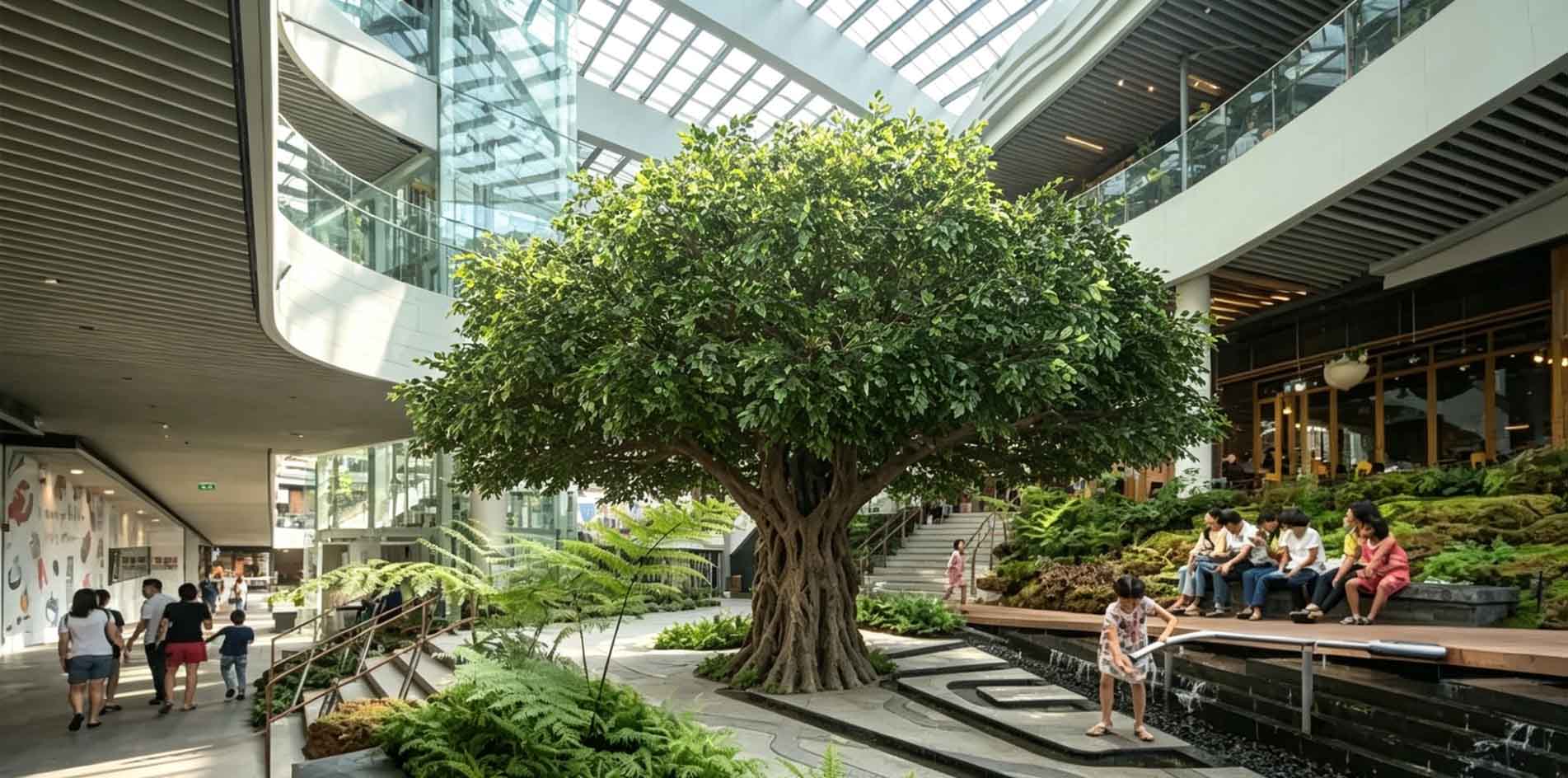
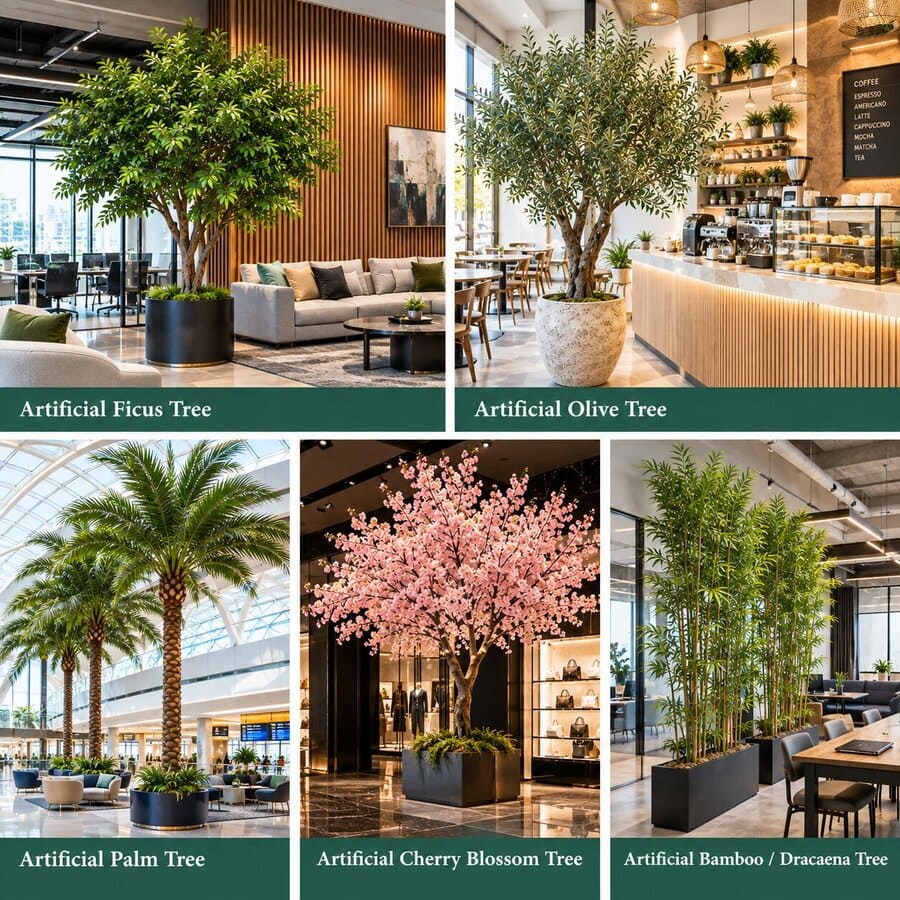
    Artificial trees have become an increasingly practical design element for commercial interiors. Hotels, offices, restaurants, retail stores, shopping centers, and other public spaces often need greenery that contributes to the overall atmosphere while remaining visually consistent over time. Unlike small decorative plants, artificial trees can introduce height, structure, texture, and a strong visual focal point. They can also be used to soften large architectural surfaces, define different areas, frame entrances, or fill empty corners. However, choosing an artificial tree for a commercial project is different from choosing one for a residential room. Commercial interiors usually have larger floor areas, higher ceilings, heavier foot traffic, and more specific requirements for appearance, placement, maintenance, and durability. Among the many options available, five types are particularly versatile for commercial interiors: artificial ficus trees, artificial olive trees, artificial palm trees, artificial cherry blossom trees, and artificial bamboo or dracaena trees.   Why Are Artificial Trees Popular in Commercial Interiors? Commercial spaces often need greenery in areas where maintaining living plants can be difficult. A hotel lobby, for example, may have limited natural light or a large open floor plan. An office reception area may need a consistent appearance throughout the year. Restaurants and retail stores may also prefer decorative greenery that does not require regular watering, pruning, or replacement. Artificial trees can provide a stable visual solution for these environments. Consistent Appearance One of the main characteristics of artificial trees is their consistent appearance. The foliage does not depend on sunlight, irrigation, seasonal growth, or temperature in the same way as a living tree. This can be useful for businesses that want their interior design to remain consistent throughout the year. Flexible Placement Artificial trees can be used in locations where living plants may not perform well, including interior corners, corridors, reception areas, and spaces with limited natural light. Their placement can also be planned around furniture, entrances, circulation routes, and architectural features. Strong Visual Impact A large artificial tree can occupy vertical space without requiring a large amount of floor area. This makes it useful in spaces with high ceilings or large empty walls. For commercial interiors, the right tree is therefore not simply a decorative object. It can become part of the overall spatial design.   1. Artificial Ficus Trees Artificial ficus trees are one of the most versatile choices for commercial interiors. Their dense foliage, branching structure, and natural-looking canopy make them suitable for a wide range of design styles. Ficus trees can work particularly well in offices, hotels, shopping centers, restaurants, reception areas, and large commercial interiors. Why Choose an Artificial Ficus Tree? The main advantage of the ficus form is its visual volume. Compared with trees with relatively narrow foliage, a ficus can create a fuller canopy and provide stronger visual presence. This makes it suitable for larger spaces where a small or narrow tree might look out of proportion. A well-designed artificial ficus tree can also create a natural transition between hard architectural surfaces and furniture. For example, a large ficus placed beside a reception desk can soften the appearance of marble, glass, metal, and other contemporary materials. Best Applications for Artificial Ficus Trees Artificial ficus trees can be considered for: Hotel lobbies Office reception areas Shopping mall atriums Restaurants Retail stores Showrooms Corporate lounges Commercial corridors For larger spaces, several ficus trees can also be arranged as a group rather than used individually. What Size Artificial Ficus Tree Should You Choose? The appropriate height depends on the ceiling height and surrounding furniture. A tree around 150–180 cm may work well in a standard commercial interior, while spaces with higher ceilings may require trees of 200 cm, 250 cm, or more. The canopy width should also be considered. A tall tree with a very wide canopy may interfere with pedestrian circulation, while a narrow canopy may look too small in a large lobby. For commercial projects, height and canopy width should therefore be considered together.       2. Artificial Olive Trees Artificial olive trees are often selected for commercial interiors that require a cleaner and more understated appearance. Their relatively slender trunks and small leaves create a lighter visual effect than dense tropical trees. This makes them suitable for modern, minimalist, Mediterranean, Scandinavian, and contemporary interiors. Artificial olive trees are particularly common in hospitality and lifestyle-oriented spaces such as restaurants, cafés, hotels, boutiques, and office lounges. Why Are Artificial Olive Trees Popular? Olive trees can add greenery without visually overwhelming the surrounding space. Their open branch structure allows light and background architecture to remain visible through the canopy. This makes them useful when designers want greenery while maintaining a relatively open appearance. An artificial olive tree can also work well with materials such as: Natural wood Stone Concrete Marble Neutral fabrics Metal Warm-toned finishes Best Applications for Artificial Olive Trees Consider artificial olive trees for: Restaurant dining areas Hotel lounges Café interiors Office reception areas Retail boutiques Showrooms Residential-commercial developments A single olive tree can be used as an accent, while multiple trees can help create visual rhythm along a wall or seating area. Artificial Olive Trees With Real Wood Trunks For projects where realism is particularly important, artificial olive trees with natural wood trunks can provide a different appearance from fully synthetic trunks. The combination of natural trunk texture and artificial foliage can create a more organic visual effect. However, the appropriate trunk material depends on the project requirements, budget, installation method, and desired appearance.          3. Artificial Palm Trees Artificial palm trees are a popular option when the objective is to create a stronger tropical, resort, or leisure-oriented atmosphere. Compared with olive or ficus trees, palm trees usually have a more recognizable silhouette. Their tall trunks and broad fronds can create a dramatic vertical effect, especially in interiors with high ceilings. Where Are Artificial Palm Trees Used? Artificial palm trees can be particularly suitable for: Hotels Resorts Shopping malls Restaurants Spas Leisure facilities Tropical-themed commercial spaces Travel-related retail environments Their visual character can help establish a specific design theme rather than simply adding neutral greenery. Palm Trees for High-Ceiling Interiors One of the main advantages of artificial palm trees is their ability to occupy vertical space. A relatively small tree may disappear visually in a large atrium. A taller palm, however, can connect the floor area with the upper portion of the interior. When selecting a palm tree, consider: Ceiling height Available floor space Frond spread Viewing distance Pedestrian circulation Planter size Overall interior theme The goal is to achieve a proportion that feels intentional rather than simply choosing the tallest available option.       4. Artificial Cherry Blossom Trees Artificial cherry blossom trees are different from ficus, olive, and palm trees because their primary role is often decorative and experiential. Their flowers can create a strong visual focal point and are especially suitable for spaces where atmosphere and visual identity are important. Cherry blossom trees are commonly considered for hotels, restaurants, retail stores, wedding venues, event spaces, and themed commercial interiors. Why Use Artificial Cherry Blossom Trees? A flowering artificial tree can introduce color and seasonal character into a space without relying on a particular flowering period. This can be useful for commercial environments that need a consistent decorative theme throughout the year. For example, a large cherry blossom tree can be used near: Hotel reception areas Restaurant entrances Shopping mall displays Luxury boutiques Event venues Wedding spaces Photo areas Seasonal installations Cherry Blossom Trees as Focal Points Unlike a simple green tree that blends into the background, a flowering tree can become one of the main visual elements in a room. For this reason, placement is particularly important. A cherry blossom tree can be positioned where visitors naturally pause or where the tree can be seen from multiple directions. In retail environments, it may also be integrated into a branded display or seasonal installation.       5. Artificial Bamboo and Dracaena Trees Artificial bamboo and dracaena trees offer another useful option for commercial interiors, especially when vertical greenery is needed but the available floor area is limited. Their relatively narrow and upright forms can work well in corridors, entrances, offices, restaurants, hotels, and areas where a wider canopy would interfere with circulation. Why Choose Bamboo or Dracaena? The main characteristic of these artificial trees is their vertical structure. Instead of creating a wide focal point, they can emphasize height while taking up comparatively little floor space. This makes them suitable for: Narrow corners Corridors Room dividers Reception areas Restaurant seating zones Hotel hallways Office breakout areas Using Artificial Trees as Space Dividers Artificial bamboo and dracaena can also be arranged in groups to create a soft visual separation between different areas. For example, a restaurant may use a group of tall artificial trees between dining tables and a circulation path. An office may use them to create a visual boundary between a lounge and a working area. This approach provides some separation without requiring a permanent architectural partition.         How to Choose the Right Artificial Tree for a Commercial Interior Choosing between different artificial trees should begin with the space rather than the tree itself. The same artificial tree may work well in one commercial environment but feel too large, too small, or visually inappropriate in another. 1. Consider Ceiling Height Ceiling height is one of the first measurements to check. Low-ceiling interiors generally work better with medium-height artificial trees. Larger lobbies and atriums can accommodate taller trees and larger canopies. A useful starting point is to leave sufficient visual space between the top of the tree and the ceiling rather than placing the canopy directly against it. 2. Measure the Available Floor Space Height is only one part of the equation. The canopy diameter and planter footprint should also be measured. For busy commercial interiors, make sure the tree does not obstruct: Walkways Emergency exits Doorways Escalators Reception desks Seating areas Service routes 3. Match the Tree With the Interior Style Different trees communicate different visual styles. Tree Type Typical Visual Character Common Commercial Applications Ficus Full and natural Offices, hotels, malls Olive Light and elegant Restaurants, cafés, boutiques Palm Tropical and dramatic Resorts, hotels, leisure spaces Cherry Blossom Decorative and expressive Retail, events, hotels Bamboo / Dracaena Tall and structured Offices, corridors, restaurants These are general design directions rather than strict rules. The final choice should be based on the specific project. 4. Consider Viewing Distance A tree that looks realistic from two meters away may not have the same visual effect when viewed from ten meters away. Large commercial interiors often require larger leaves, stronger branching structures, and greater canopy volume so the tree remains visually effective from a distance. For large lobbies and atriums, the overall silhouette may therefore be more important than small botanical details. 5. Consider Maintenance Requirements One reason businesses consider artificial trees is to reduce routine plant maintenance. Artificial trees do not require watering, pruning, fertilizing, or sunlight in the same way as living trees. However, they still need occasional cleaning to remove dust and maintain their appearance. For restaurants, hotels, and other high-traffic environments, the cleaning schedule should be considered during product selection.   Artificial Trees for Different Commercial Spaces Different commercial environments have different design requirements. Hotels Hotel lobbies often benefit from larger statement trees because these spaces usually have higher ceilings and wider sightlines. Ficus, olive, palm, and flowering trees can all be considered depending on the hotel's design language. Offices Office environments generally benefit from trees that look natural without becoming too visually dominant. Olive, ficus, dracaena, and bamboo are suitable options for reception areas, lounges, meeting spaces, and shared areas. Restaurants and Cafés Restaurants often use artificial trees to create atmosphere and define seating areas. Olive trees can work well in minimalist or Mediterranean interiors, while palms and tropical trees can suit more themed environments. Retail Stores and Shopping Malls Retail environments may require stronger visual elements. Large ficus trees, palms, and flowering trees can be used as focal points, while smaller artificial trees can complement product displays.   Frequently Asked Questions About Artificial Trees for Commercial Interiors Are artificial trees suitable for hotel lobbies? Yes. Artificial trees can be used in hotel lobbies as focal points, decorative elements, or ways to soften large architectural spaces. The appropriate species and size depend on ceiling height, available floor space, and interior design. What is the most versatile artificial tree for commercial spaces? Ficus is one versatile option because its full canopy can work across offices, hotels, retail spaces, and other commercial interiors. However, versatility does not mean it is the best choice for every project. Are artificial olive trees suitable for restaurants? Yes. Their relatively open canopy and understated appearance can work well in restaurants, cafés, hotel lounges, and contemporary commercial interiors. Are artificial palm trees suitable for indoor use? Yes. Artificial palms can be used indoors, particularly in hotels, resorts, shopping centers, restaurants, and leisure-oriented spaces. The tree should be selected according to the ceiling height and available floor space. How tall should an artificial tree be for a commercial interior? There is no universal height. The decision should consider ceiling height, furniture scale, viewing distance, canopy width, and pedestrian circulation. Standard commercial interiors may use medium-height trees, while large atriums may require trees several meters tall. Can artificial trees be customized for commercial projects? Depending on the manufacturer, artificial trees can be customized in areas such as height, canopy size, foliage style, trunk design, planter configuration, and packaging. Customization can be particularly useful for hotels, malls, restaurants, and other projects with specific spatial requirements.    
  • From Molded Leaves to Finished Trees: See How Artificial Plants Are Made
    Aug 24, 2026
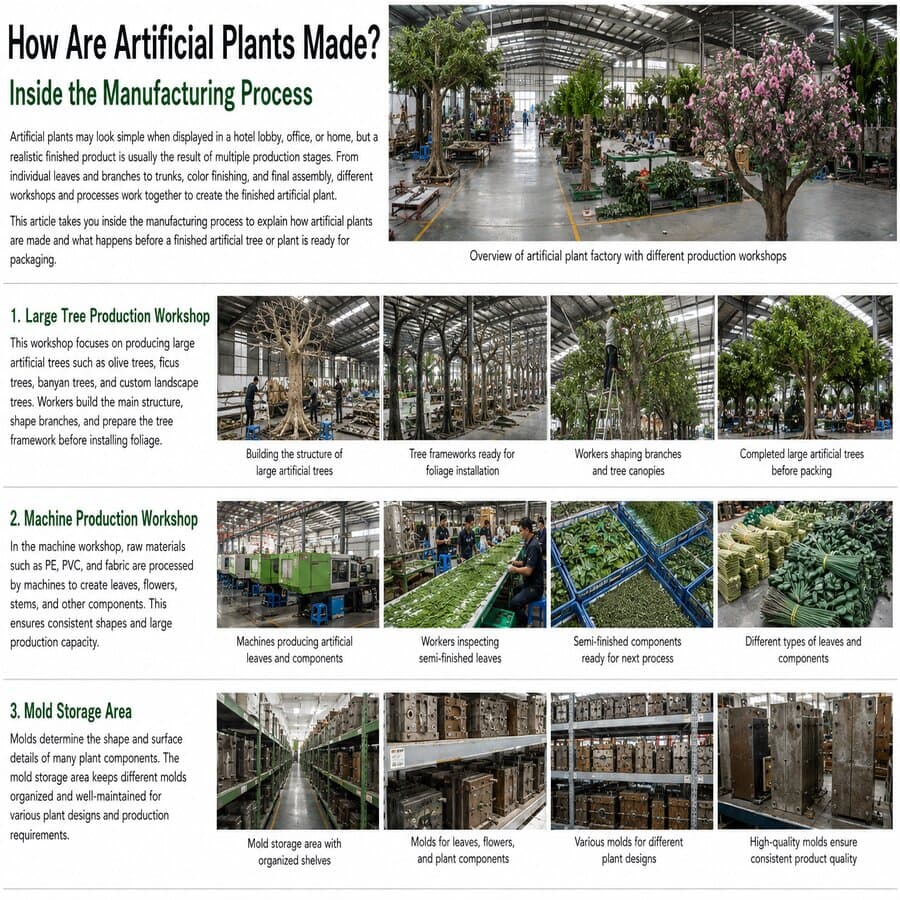
    Artificial plants may look simple when displayed in a hotel lobby, office, shopping mall, restaurant, or home, but a realistic finished product is usually the result of multiple production stages. From individual leaves and branches to trunks, color finishing, and final assembly, different workshops and processes work together to create the finished artificial plant. The manufacturing process can vary depending on the product type. Small potted plants, artificial flowers, artificial trees, and large landscape trees may use different materials and production methods. However, several key stages are commonly involved in professional artificial plant manufacturing, including component production, mold preparation, color finishing, and assembly. At Yum Plant, the production environment includes a large tree workshop, machine room, mold room, spray painting room, and assembly workshop. These different areas support the production of artificial plants and trees at different stages. This article takes you inside the manufacturing process to explain how artificial plants are made and what happens before a finished artificial tree or plant is ready for packaging.               Understanding the Artificial Plant Manufacturing Process Before looking at individual workshops, it is useful to understand the general production flow. A typical artificial plant manufacturing process may include: Product design and material preparation Mold development and storage Machine production of leaves and components Production of trunks and large tree structures Color spraying and surface finishing Manual assembly Quality inspection Packaging and shipment Not every artificial plant follows exactly the same process. For example, an artificial olive tree with a real wood trunk may require different production steps from a molded artificial palm tree. A large custom landscape tree may also require a stronger internal structure and more manual work than a small potted artificial plant. The goal of the manufacturing process is not simply to produce plant-shaped products. Manufacturers also need to consider details such as leaf texture, branch structure, color variation, product stability, transportation requirements, and final appearance. Modern artificial plant manufacturing often combines machine production with manual craftsmanship. Plastic components can be formed through molding processes, while workers may complete coloring, shaping, branch installation, and final assembly by hand.   1. Large Artificial Tree Production Workshop Where Large Artificial Trees Take Shape The large tree production workshop is one of the most important areas in the manufacturing process of oversized artificial trees. Large artificial trees require more production space because their trunks, branches, and canopies can be several meters high. Unlike small potted plants, large trees cannot always be produced efficiently on a standard workstation. In this workshop, workers may produce or prepare components for products such as: Large artificial olive trees Artificial ficus trees Artificial banyan trees Artificial landscape trees Artificial palm trees Custom decorative trees Large artificial trees for hotels and shopping malls The production process often begins with the main structure. Creating the Tree Structure The internal structure provides the basic shape and stability of a large artificial tree. Depending on the design, the structure may include metal frames, pipes, reinforced branches, artificial trunks, or other supporting materials. The structure must be designed according to the size and application of the finished tree. For example, a large artificial tree intended for a hotel lobby may need to consider: Overall height Canopy width Installation method Weight Structural stability Transportation requirements Large trees may also be designed in separate sections. A modular structure can make transportation and installation more practical, especially when the finished product is too large to ship as one complete unit. Developing a Natural Tree Shape One of the challenges in manufacturing large artificial trees is creating a structure that looks natural. Real trees do not usually grow in perfectly symmetrical patterns. Their branches vary in direction, angle, thickness, and length. During the production process, workers may adjust the main branches and secondary branches to create a more natural visual structure. The objective is to avoid making the artificial tree appear overly uniform. The trunk and branch system provides the foundation for later stages of the manufacturing process. Once the structure is ready, foliage, smaller branches, and decorative details can be added. Large Trees Require More Manual Work Large artificial tree production often involves a higher level of manual work compared with smaller machine-produced plants. Workers may need to: Position branches Adjust branch angles Install foliage Shape the canopy Check the balance of the tree Adjust the overall silhouette This is particularly important for custom artificial trees. Customers may have specific requirements for tree height, canopy width, trunk style, or installation location.           2. Machine Production Workshop Producing Leaves and Plant Components The machine production workshop is where many of the individual components used in artificial plants are produced or processed. Artificial leaves, flowers, stems, and other components can be made from materials such as PE, PVC, fabric, polyester, and other specialized materials depending on the product design. For molded plastic artificial plants, injection molding is commonly used to create detailed components. Heated plastic material is introduced into a mold, where it takes the shape of the desired leaf, flower, or plant part before cooling and removal. The machine workshop can therefore play an important role in creating consistent shapes and producing components in larger quantities. From Raw Materials to Plant Components The process begins with the selected material. Different artificial plants may require different properties. For example: Flexible leaves may require softer materials. Outdoor products may require materials suitable for additional weather-resistance treatments. Structural components may require stronger materials. Decorative flowers may require detailed shapes and textures. The material is processed through production equipment and molds to create the required components. Depending on the product, the output may include: Individual leaves Leaf clusters Flower petals Branch sections Stems Plastic connectors Decorative components These components may still require additional processing before becoming part of a finished artificial plant. Why Machine Production Is Important Machine production helps manufacturers produce components with consistent dimensions and repeated details. For artificial foliage, consistency is useful because a finished tree may contain hundreds or even thousands of individual leaves. However, consistency alone does not determine whether an artificial plant looks realistic. The final appearance also depends on color, texture, assembly, branch arrangement, and finishing. This is why machine production is often followed by manual processing. Semi-Finished Products Move to the Next Workshop After components are produced, they may be inspected, trimmed, grouped, or transferred to other production areas. Some components go directly to assembly. Others may first need color spraying or surface finishing. The movement of semi-finished products between workshops is an important part of the artificial plant manufacturing process.           3. Mold Storage Area The Importance of Molds in Artificial Plant Manufacturing The mold storage area may not be the most visually impressive part of an artificial plant factory, but it plays an important role in product development and production. A mold determines the basic shape and surface details of many molded artificial plant components. For example, a mold can be developed for: Olive leaves Ficus leaves Palm leaves Artificial flowers Plant stems Branch components Decorative plant details Different molds are required for different product designs and sizes. Creating Realistic Leaf Details The quality and design of a mold can influence the appearance of the finished component. A realistic artificial leaf may include details such as: Leaf veins Natural curves Surface texture Thickness variation Edge shape When molten material is processed through a mold, these details can become part of the finished component. Because artificial plants come in many species and styles, manufacturers may need a large collection of molds to support different product ranges. Yum Plant's factory information specifically includes a mold room as part of its production facilities. Mold Organization and Storage Proper mold storage helps protect production tools and makes it easier to manage different product designs. Molds may be organized according to: Product category Plant species Product size Production requirements Customer projects When a new artificial plant is developed, the production team may use an existing mold or create a new one depending on the product requirements. Supporting Product Customization Molds can also support product development and customization. For a manufacturer offering different artificial plant designs, the ability to manage and develop molds provides greater flexibility when expanding a product range. However, customization does not always require a completely new mold. Some projects may be customized through different combinations of existing components, colors, trunks, branches, or assembly methods.     4. Spray Painting Workshop Adding Natural Color and Visual Depth After leaves, branches, or other plant components are produced, some products move to the spray painting workshop. Color is one of the factors that can influence whether an artificial plant looks natural. Real plants rarely have a single, perfectly uniform color. A natural leaf may include: Darker edges Lighter centers Different shades of green Brown or yellow details Gradual color transitions The spray painting process can be used to add visual variation to artificial plant components. Creating Different Color Layers Depending on the product design, workers may apply one or more layers of color. For example, an artificial leaf may start with a base color and later receive additional color treatments to create greater visual depth. Different plant species require different color combinations. An artificial olive tree may use muted green and gray-green tones, while a tropical artificial plant may require deeper or brighter shades. The color process therefore needs to match the intended appearance of the finished plant. Manual Color Finishing n some cases, manual spraying allows workers to apply color selectively. This can be useful when creating: Color gradients Leaf edge details Natural-looking variation Trunk textures Branch details The purpose is not necessarily to make every component identical. Controlled variation can help create a more natural overall appearance. Artificial plant manufacturers may use spraying, painting, dyeing, or other finishing techniques depending on the materials and product requirements. Surface Finishing and Product Appearance The surface finish can also affect how artificial plants look under indoor lighting or natural light. A highly reflective plastic surface may appear different from a matte or textured surface. For this reason, the finishing process can contribute to the overall visual result of the product. After the color treatment is completed and the components are ready, they can be transferred to the assembly workshop.     5. Assembly Workshop Bringing All the Components Together The assembly workshop is where individual components are transformed into finished artificial plants. By this stage, the factory may already have produced: Leaves Branches Stems Trunks Flowers Structural components Decorative accessories The assembly process combines these components according to the product design. For many artificial plants, assembly requires careful manual work. Workers may attach leaves to branches, combine branches with trunks, secure components, adjust foliage, and shape the finished product. Building a Natural-Looking Canopy The arrangement of foliage can significantly influence the appearance of an artificial tree. Even when all leaves are identical, the finished tree may look different depending on: Leaf spacing Branch direction Branch length Foliage density Canopy shape During assembly, workers arrange the components to create the intended shape. The goal is usually to create a balanced and natural-looking appearance while maintaining the product specifications. Assembly of Small and Large Artificial Plants Small artificial plants may be assembled on worktables or production lines. Large artificial trees may require more space and additional workers. For large products, assembly can include: Installing the main trunk Connecting major branches Adding secondary branches Installing foliage Adjusting the overall shape Inspecting the finished product The final tree may then be partially disassembled or compressed for packaging depending on the product design and shipping requirements. Quality Inspection During Assembly Quality checks can take place throughout the production process, including during final assembly. Workers or inspectors may check: Leaf attachment Branch stability Product dimensions Color consistency Overall appearance Missing components Packaging readiness The final inspection helps identify visible issues before products move to the packaging stage.           From Separate Components to a Finished Artificial Plant The manufacturing process of an artificial plant is a combination of production technology and manual work. A single artificial tree may begin as a collection of separate components: Raw materials Molds Molded leaves Branch sections Trunk structures Color-finished components These parts are gradually transformed into a finished product through different workshops. The large tree production workshop focuses on structure and oversized products. The machine production workshop creates and processes individual components. The mold storage area supports product shapes and production requirements. The spray painting workshop adds color and visual details. Finally, the assembly workshop brings all components together. Each stage has a different function, but the final appearance depends on how these stages work together.   Frequently Asked Questions About Artificial Plant Manufacturing How are artificial plants made? Artificial plants are generally made through several stages, including component production, molding, color finishing, branch preparation, and manual assembly. The exact process depends on the type of artificial plant and the materials used. Are artificial leaves made by machines? Many artificial leaves and plastic plant components can be produced using machines and molds. After machine production, the components may require additional coloring, processing, or assembly. Why are molds important for artificial plants? Molds help create the shapes and surface details of artificial leaves, flowers, and other components. Different plant designs often require different molds. Are artificial plants assembled by hand? Many artificial plants require manual assembly, especially when workers need to attach leaves, arrange branches, shape foliage, or complete large artificial trees. How are large artificial trees made? Large artificial trees typically require a structural framework, trunk and branch preparation, foliage installation, manual shaping, and final inspection. Large products may also use modular designs to make transportation and installation easier. Why is spray painting used in artificial plant manufacturing? Spray painting can add color variation, depth, and surface details to artificial leaves, branches, and trunks. This helps create a more detailed visual appearance. What happens after an artificial plant is assembled? After assembly, the finished artificial plant can be inspected for appearance, structure, and product completeness before moving to packaging and shipment preparation.  

leave a message

leave a message
If you are interested in our products and want to know more details,please leave a message here,we will reply you as soon as we can.

Home

Products

WhatsApp

contact