From Molded Leaves to Finished Trees: See How Artificial Plants Are Made
Aug 24, 2026
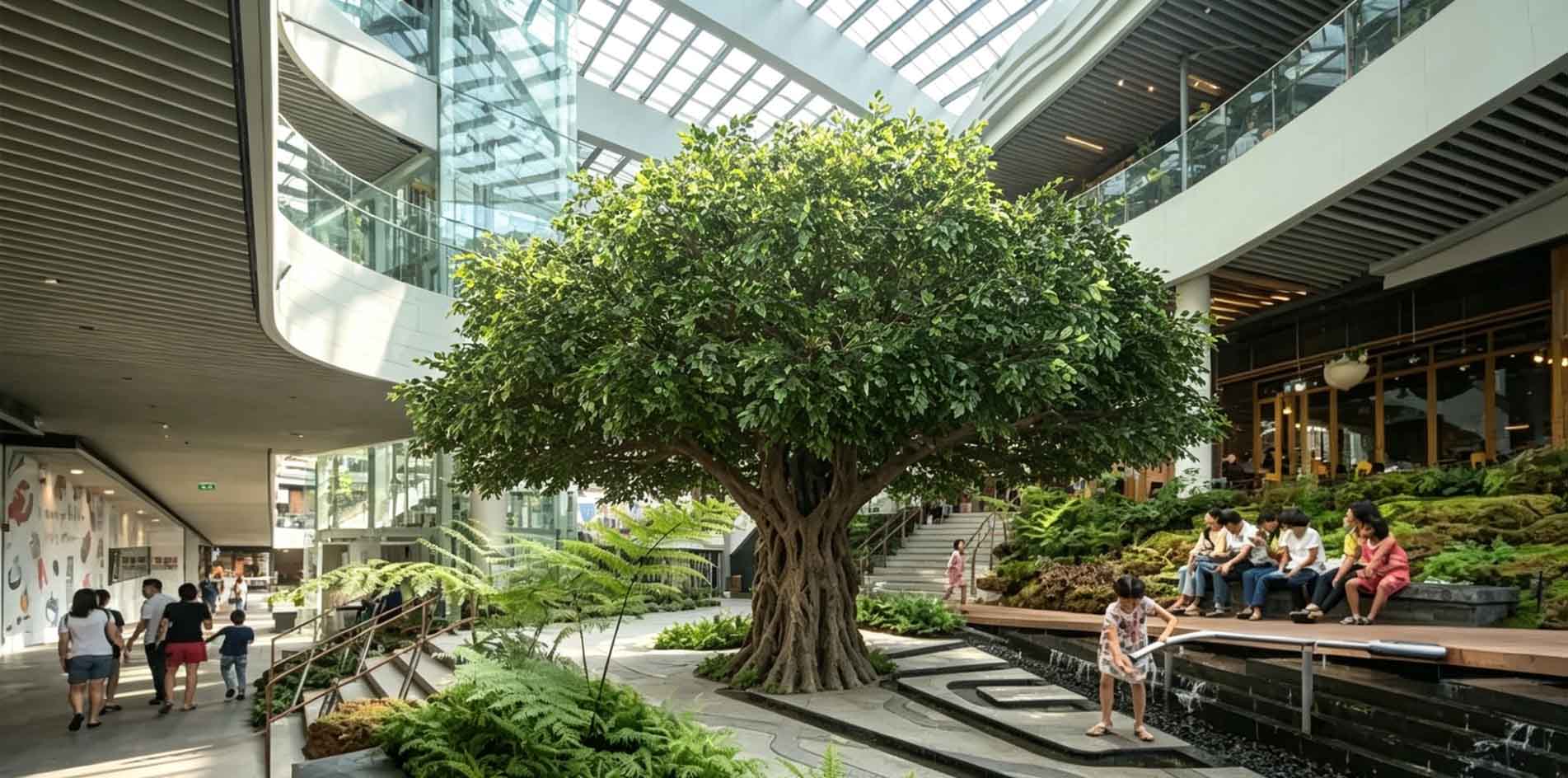
Artificial plants may look simple when displayed in a hotel lobby, office, shopping mall, restaurant, or home, but a realistic finished product is usually the result of multiple production stages. From individual leaves and branches to trunks, color finishing, and final assembly, different workshops and processes work together to create the finished artificial plant.
The manufacturing process can vary depending on the product type. Small potted plants, artificial flowers, artificial trees, and large landscape trees may use different materials and production methods. However, several key stages are commonly involved in professional artificial plant manufacturing, including component production, mold preparation, color finishing, and assembly.
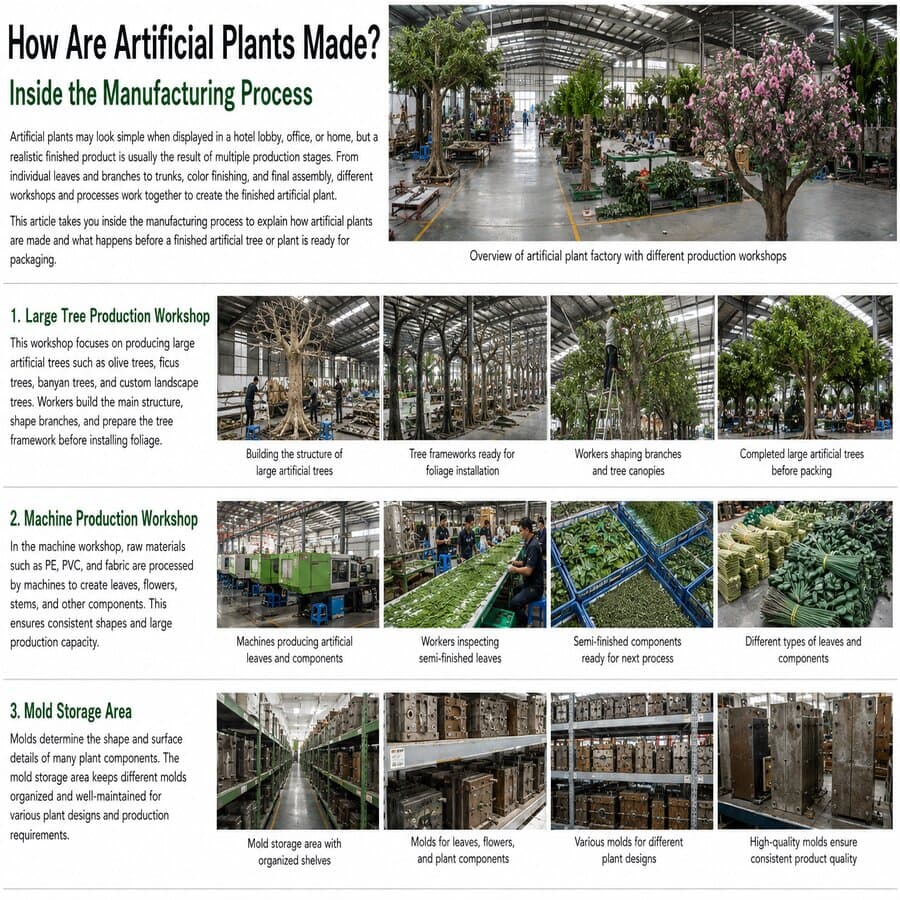
At Yum Plant, the production environment includes a large tree workshop, machine room, mold room, spray painting room, and assembly workshop. These different areas support the production of artificial plants and trees at different stages.
This article takes you inside the manufacturing process to explain how artificial plants are made and what happens before a finished artificial tree or plant is ready for packaging.
Understanding the Artificial Plant Manufacturing Process
Before looking at individual workshops, it is useful to understand the general production flow.
A typical artificial plant manufacturing process may include:
Product design and material preparation
Mold development and storage
Machine production of leaves and components
Production of trunks and large tree structures
Color spraying and surface finishing
Manual assembly
Quality inspection
Packaging and shipment
Not every artificial plant follows exactly the same process. For example, an artificial olive tree with a real wood trunk may require different production steps from a molded artificial palm tree. A large custom landscape tree may also require a stronger internal structure and more manual work than a small potted artificial plant.
The goal of the manufacturing process is not simply to produce plant-shaped products. Manufacturers also need to consider details such as leaf texture, branch structure, color variation, product stability, transportation requirements, and final appearance.
Modern artificial plant manufacturing often combines machine production with manual craftsmanship. Plastic components can be formed through molding processes, while workers may complete coloring, shaping, branch installation, and final assembly by hand.
1. Large Artificial Tree Production Workshop
Where Large Artificial Trees Take Shape
The large tree production workshop is one of the most important areas in the manufacturing process of oversized artificial trees.
Large artificial trees require more production space because their trunks, branches, and canopies can be several meters high. Unlike small potted plants, large trees cannot always be produced efficiently on a standard workstation.
In this workshop, workers may produce or prepare components for products such as:
Large artificial olive trees
Artificial ficus trees
Artificial banyan trees
Artificial landscape trees
Artificial palm trees
Custom decorative trees
Large artificial trees for hotels and shopping malls
The production process often begins with the main structure.
Creating the Tree Structure
The internal structure provides the basic shape and stability of a large artificial tree. Depending on the design, the structure may include metal frames, pipes, reinforced branches, artificial trunks, or other supporting materials.
The structure must be designed according to the size and application of the finished tree.
For example, a large artificial tree intended for a hotel lobby may need to consider:
Overall height
Canopy width
Installation method
Weight
Structural stability
Transportation requirements
Large trees may also be designed in separate sections. A modular structure can make transportation and installation more practical, especially when the finished product is too large to ship as one complete unit.
Developing a Natural Tree Shape
One of the challenges in manufacturing large artificial trees is creating a structure that looks natural.
Real trees do not usually grow in perfectly symmetrical patterns. Their branches vary in direction, angle, thickness, and length.
During the production process, workers may adjust the main branches and secondary branches to create a more natural visual structure. The objective is to avoid making the artificial tree appear overly uniform.
The trunk and branch system provides the foundation for later stages of the manufacturing process. Once the structure is ready, foliage, smaller branches, and decorative details can be added.
Large Trees Require More Manual Work
Large artificial tree production often involves a higher level of manual work compared with smaller machine-produced plants.
Workers may need to:
Position branches
Adjust branch angles
Install foliage
Shape the canopy
Check the balance of the tree
Adjust the overall silhouette
This is particularly important for custom artificial trees. Customers may have specific requirements for tree height, canopy width, trunk style, or installation location.
2. Machine Production Workshop
Producing Leaves and Plant Components
The machine production workshop is where many of the individual components used in artificial plants are produced or processed.
Artificial leaves, flowers, stems, and other components can be made from materials such as PE, PVC, fabric, polyester, and other specialized materials depending on the product design.
For molded plastic artificial plants, injection molding is commonly used to create detailed components. Heated plastic material is introduced into a mold, where it takes the shape of the desired leaf, flower, or plant part before cooling and removal.
The machine workshop can therefore play an important role in creating consistent shapes and producing components in larger quantities.
From Raw Materials to Plant Components
The process begins with the selected material.
Different artificial plants may require different properties. For example:
Flexible leaves may require softer materials.
Outdoor products may require materials suitable for additional weather-resistance treatments.
Structural components may require stronger materials.
Decorative flowers may require detailed shapes and textures.
The material is processed through production equipment and molds to create the required components.
Depending on the product, the output may include:
Individual leaves
Leaf clusters
Flower petals
Branch sections
Stems
Plastic connectors
Decorative components
These components may still require additional processing before becoming part of a finished artificial plant.
Why Machine Production Is Important
Machine production helps manufacturers produce components with consistent dimensions and repeated details.
For artificial foliage, consistency is useful because a finished tree may contain hundreds or even thousands of individual leaves.
However, consistency alone does not determine whether an artificial plant looks realistic. The final appearance also depends on color, texture, assembly, branch arrangement, and finishing.
This is why machine production is often followed by manual processing.
Semi-Finished Products Move to the Next Workshop
After components are produced, they may be inspected, trimmed, grouped, or transferred to other production areas.
Some components go directly to assembly. Others may first need color spraying or surface finishing.
The movement of semi-finished products between workshops is an important part of the artificial plant manufacturing process.
3. Mold Storage Area
The Importance of Molds in Artificial Plant Manufacturing
The mold storage area may not be the most visually impressive part of an artificial plant factory, but it plays an important role in product development and production.
A mold determines the basic shape and surface details of many molded artificial plant components.
For example, a mold can be developed for:
Olive leaves
Ficus leaves
Palm leaves
Artificial flowers
Plant stems
Branch components
Decorative plant details
Different molds are required for different product designs and sizes.
Creating Realistic Leaf Details
The quality and design of a mold can influence the appearance of the finished component.
A realistic artificial leaf may include details such as:
Leaf veins
Natural curves
Surface texture
Thickness variation
Edge shape
When molten material is processed through a mold, these details can become part of the finished component.
Because artificial plants come in many species and styles, manufacturers may need a large collection of molds to support different product ranges.
Yum Plant's factory information specifically includes a mold room as part of its production facilities.
Mold Organization and Storage
Proper mold storage helps protect production tools and makes it easier to manage different product designs.
Molds may be organized according to:
Product category
Plant species
Product size
Production requirements
Customer projects
When a new artificial plant is developed, the production team may use an existing mold or create a new one depending on the product requirements.
Supporting Product Customization
Molds can also support product development and customization.
For a manufacturer offering different artificial plant designs, the ability to manage and develop molds provides greater flexibility when expanding a product range.
However, customization does not always require a completely new mold. Some projects may be customized through different combinations of existing components, colors, trunks, branches, or assembly methods.
4. Spray Painting Workshop
Adding Natural Color and Visual Depth
After leaves, branches, or other plant components are produced, some products move to the spray painting workshop.
Color is one of the factors that can influence whether an artificial plant looks natural.
Real plants rarely have a single, perfectly uniform color. A natural leaf may include:
Darker edges
Lighter centers
Different shades of green
Brown or yellow details
Gradual color transitions
The spray painting process can be used to add visual variation to artificial plant components.
Creating Different Color Layers
Depending on the product design, workers may apply one or more layers of color.
For example, an artificial leaf may start with a base color and later receive additional color treatments to create greater visual depth.
Different plant species require different color combinations.
An artificial olive tree may use muted green and gray-green tones, while a tropical artificial plant may require deeper or brighter shades.
The color process therefore needs to match the intended appearance of the finished plant.
Manual Color Finishing
n some cases, manual spraying allows workers to apply color selectively.
This can be useful when creating:
Color gradients
Leaf edge details
Natural-looking variation
Trunk textures
Branch details
The purpose is not necessarily to make every component identical. Controlled variation can help create a more natural overall appearance.
Artificial plant manufacturers may use spraying, painting, dyeing, or other finishing techniques depending on the materials and product requirements.
Surface Finishing and Product Appearance
The surface finish can also affect how artificial plants look under indoor lighting or natural light.
A highly reflective plastic surface may appear different from a matte or textured surface.
For this reason, the finishing process can contribute to the overall visual result of the product.
After the color treatment is completed and the components are ready, they can be transferred to the assembly workshop.
5. Assembly Workshop
Bringing All the Components Together
The assembly workshop is where individual components are transformed into finished artificial plants.
By this stage, the factory may already have produced:
Leaves
Branches
Stems
Trunks
Flowers
Structural components
Decorative accessories
The assembly process combines these components according to the product design.
For many artificial plants, assembly requires careful manual work.
Workers may attach leaves to branches, combine branches with trunks, secure components, adjust foliage, and shape the finished product.
Building a Natural-Looking Canopy
The arrangement of foliage can significantly influence the appearance of an artificial tree.
Even when all leaves are identical, the finished tree may look different depending on:
Leaf spacing
Branch direction
Branch length
Foliage density
Canopy shape
During assembly, workers arrange the components to create the intended shape.
The goal is usually to create a balanced and natural-looking appearance while maintaining the product specifications.
Assembly of Small and Large Artificial Plants
Small artificial plants may be assembled on worktables or production lines.
Large artificial trees may require more space and additional workers.
For large products, assembly can include:
Installing the main trunk
Connecting major branches
Adding secondary branches
Installing foliage
Adjusting the overall shape
Inspecting the finished product
The final tree may then be partially disassembled or compressed for packaging depending on the product design and shipping requirements.
Quality Inspection During Assembly
Quality checks can take place throughout the production process, including during final assembly.
Workers or inspectors may check:
Leaf attachment
Branch stability
Product dimensions
Color consistency
Overall appearance
Missing components
Packaging readiness
The final inspection helps identify visible issues before products move to the packaging stage.
From Separate Components to a Finished Artificial Plant
The manufacturing process of an artificial plant is a combination of production technology and manual work.
A single artificial tree may begin as a collection of separate components:
Raw materials
Molds
Molded leaves
Branch sections
Trunk structures
Color-finished components
These parts are gradually transformed into a finished product through different workshops.
The large tree production workshop focuses on structure and oversized products. The machine production workshop creates and processes individual components. The mold storage area supports product shapes and production requirements. The spray painting workshop adds color and visual details. Finally, the assembly workshop brings all components together.
Each stage has a different function, but the final appearance depends on how these stages work together.
Frequently Asked Questions About Artificial Plant Manufacturing
How are artificial plants made?
Artificial plants are generally made through several stages, including component production, molding, color finishing, branch preparation, and manual assembly. The exact process depends on the type of artificial plant and the materials used.
Are artificial leaves made by machines?
Many artificial leaves and plastic plant components can be produced using machines and molds. After machine production, the components may require additional coloring, processing, or assembly.
Why are molds important for artificial plants?
Molds help create the shapes and surface details of artificial leaves, flowers, and other components. Different plant designs often require different molds.
Are artificial plants assembled by hand?
Many artificial plants require manual assembly, especially when workers need to attach leaves, arrange branches, shape foliage, or complete large artificial trees.
How are large artificial trees made?
Large artificial trees typically require a structural framework, trunk and branch preparation, foliage installation, manual shaping, and final inspection. Large products may also use modular designs to make transportation and installation easier.
Why is spray painting used in artificial plant manufacturing?
Spray painting can add color variation, depth, and surface details to artificial leaves, branches, and trunks. This helps create a more detailed visual appearance.
What happens after an artificial plant is assembled?
After assembly, the finished artificial plant can be inspected for appearance, structure, and product completeness before moving to packaging and shipment preparation.