How to Choose Artificial Plants for an Office Desk
Sep 14, 2026
Small artificial plants can be a practical way to add greenery to an office desk without requiring regular watering, sunlight, or daily care. From compact succulents and ferns to small pothos and flowering plants, there are many options that can work with different desk sizes and office styles.
An office desk is usually a limited space. A computer, monitor, keyboard, documents, stationery and other working items already occupy much of the available surface. For this reason, choosing an artificial plant for an office desk is not simply about finding the smallest plant available. Size, shape, pot style, color, realism and maintenance requirements can all affect whether the plant works well in the space.
This guide looks at different types of artificial plants for office desks, how to choose them, and how they can be used in different office environments.
Why Use Artificial Plants on an Office Desk?
Plants are often used in offices to introduce a natural element into an otherwise functional environment. However, real plants require suitable light, watering and ongoing care. Some office desks may be located far from windows or in air-conditioned environments where plant care can be difficult.
Artificial desk plants offer another option.
A small artificial plant does not depend on natural light and does not require watering. It can remain on a desk throughout the working week without someone having to remember to maintain it.
For offices with shared workspaces, reception areas, meeting rooms or individual workstations, this can make artificial plants convenient for adding decorative greenery.
The main benefits include:
No watering required
No sunlight required
Suitable for offices with limited natural light
Easy to move between workspaces
Available in many sizes and styles
Suitable for long-term indoor decoration
Simple to clean with occasional dusting
These characteristics make small artificial plants for office spaces particularly suitable for workplaces where decoration needs to remain practical.
What Artificial Plants Are Best for an Office Desk?
There is no single artificial plant that is suitable for every desk. The best choice depends on the size of the workspace, interior style and the amount of visual space available.
Some of the most suitable options include small potted plants, succulents, ferns, pothos, sansevieria and small flowering plants.
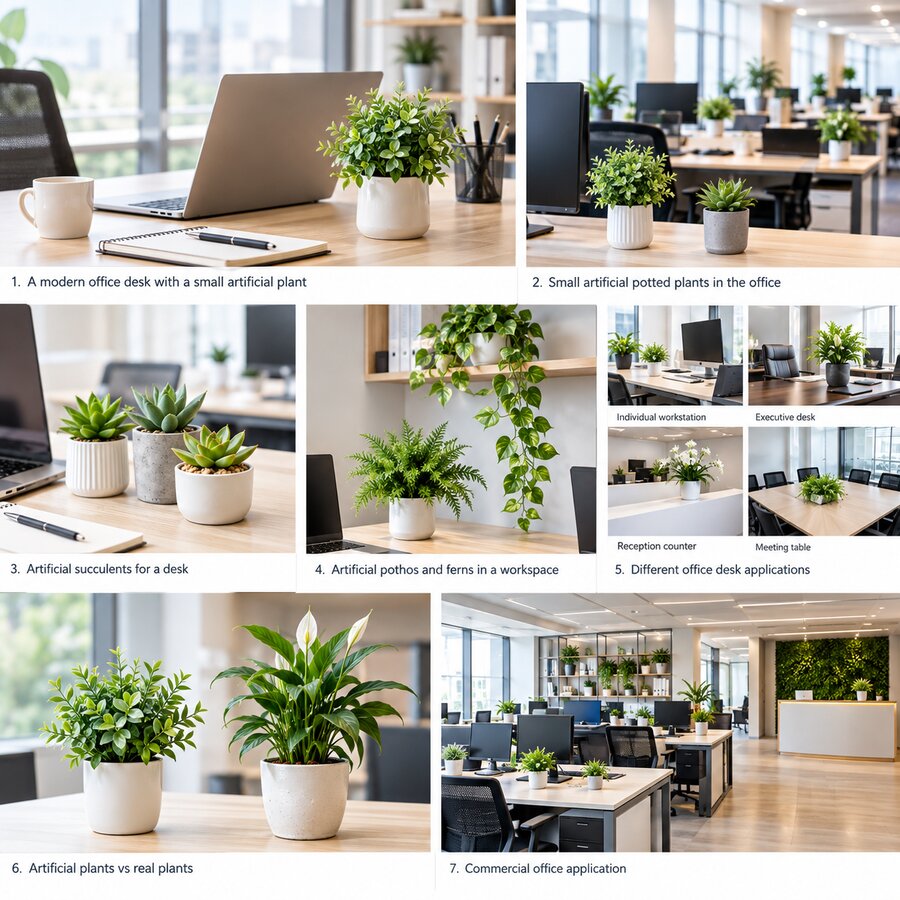
Small Artificial Potted Plants
Small artificial potted plants are among the simplest choices for an office desk.
Their compact size allows them to sit beside a computer monitor, on a corner of a desk or next to office accessories without taking up too much working space.
A small potted plant can also be selected according to the style of the office. Simple green foliage may suit a modern workspace, while a decorative pot can work better in a reception area or creative office.
For commercial projects, using several small artificial potted plants in different areas can create a consistent visual theme without making every workspace look identical.
Artificial Sansevieria
Sansevieria has a distinctive upright leaf shape, which means it can add height without requiring a wide footprint.
A small artificial sansevieria plant can therefore be useful when the desk has limited horizontal space.
The vertical leaves also create a relatively clean appearance, making this type of plant suitable for contemporary and minimalist office interiors.
For larger desks, several plants with different heights can be combined to create more visual variation.
Small Artificial Ferns
Artificial ferns have a softer and fuller appearance than plants with upright leaves.
Their fine foliage can introduce a more natural and relaxed feeling to a workspace. Depending on the design, a small fern can be placed in a compact pot or a decorative container.
Ferns are particularly suitable when the office interior uses natural materials such as wood, stone or neutral-colored furniture.
Artificial Pothos
Pothos is known for its trailing growth habit.
For an office desk, a compact artificial pothos can be placed in a pot near the edge of a desk, allowing some foliage to extend naturally over the side.
This style can work well in creative offices, shared workspaces and home offices where a less formal appearance is preferred.
Longer artificial pothos arrangements can also be placed on shelves above desks rather than directly on the working surface.
Small Artificial Flowering Plants
Green foliage is not the only option.
Small artificial flowering plants can add color to an office environment without requiring the care associated with real flowers.
Depending on the interior, subtle white, pink, yellow or other natural-looking flower colors can be used as an accent.
Flowering artificial plants may be particularly useful in reception areas, customer-facing offices and hospitality-related workspaces where a little additional color is desirable.
How to Choose the Right Artificial Plant for a Desk
Choosing an artificial desk plant should start with the available space rather than the plant itself.
Consider the Size of the Desk
Plant height can affect how the workspace feels.
Low-growing plants are usually suitable for areas directly beside a computer or monitor. Taller plants can be placed toward the back or corner of a desk.
However, plants placed directly in front of a monitor should not block the user's view.
For office desks with limited space, an upright plant can sometimes provide greenery while using less surface area than a wide arrangement.
Choose a Suitable Pot
The pot is an important part of the overall appearance.
A realistic artificial plant can look less natural if it is placed in a pot that does not match its size or style.
Common choices include:
Ceramic-style pots
Cement-style pots
Plastic pots
Metal containers
Woven baskets
Simple neutral-colored planters
For professional office interiors, neutral colors such as white, grey, beige, black or natural tones can be easier to coordinate with existing furniture.
Consider Leaf Shape and Color
Different foliage creates different visual effects.
Fine leaves can give an arrangement a lighter appearance, while broad leaves can create a stronger visual presence.
Green shades also vary. Some artificial plants use bright green leaves, while others use darker, muted or mixed tones.
For a realistic office arrangement, natural variations in leaf color and texture can help prevent the plant from looking overly uniform.
Consider Realism
The quality of artificial plants can vary considerably.
When choosing artificial plants for office desks, look at details such as:
Leaf texture
Leaf color variation
Stem construction
Natural-looking growth patterns
Pot proportions
Overall density
Surface finish
A plant does not necessarily need to be highly detailed to work well, but the proportions and materials should look appropriate from normal viewing distances.
Artificial Plants for Different Types of Office Desks
Different workspaces can benefit from different plant styles.
Individual Workstations
Individual desks usually have limited space.
Small artificial potted plants, succulents and compact foliage plants are practical choices.
One small plant placed near the corner of the desk can add greenery without changing the functionality of the workspace.
Executive Desks
Executive desks tend to offer more surface area.
A larger artificial plant arrangement can therefore be considered, particularly when the desk has a relatively simple design.
Instead of using one very large plant, several smaller plants with different heights can also create a balanced arrangement.
Reception Desks
Reception areas are often visible to visitors, so decorative details may have a stronger visual role.
Small artificial flowering plants, compact palms or attractive potted foliage can be used depending on the company's interior design.
The plant should complement the reception counter rather than dominate it.
Meeting Rooms
Meeting tables usually need to remain functional.
For this reason, low-profile artificial plants can be useful. A small arrangement in the center of a meeting table can introduce greenery while leaving sufficient space for documents and laptops.
For larger meeting rooms, plants can also be positioned on side cabinets, shelves or nearby floor areas instead of directly on the table.
Home Office Desks
Home offices generally offer more flexibility.
A small artificial pothos, fern, succulent or flowering plant can be placed beside a monitor, on a shelf or near books and other decorative objects.
Because home office furniture varies considerably, the plant and pot can be selected to match the existing interior rather than following a formal office style.
Artificial Plants vs. Real Plants for Office Desks
There is no fixed number that works for every desk.
For a small individual workstation, one compact artificial plant may be enough.
A larger desk may accommodate two or three small plants, particularly if they have different heights or foliage shapes.
However, adding more plants does not always improve the appearance. Too many decorative objects can make a desk feel crowded.
A practical approach is to consider the plant as part of the entire workspace. Leave enough room for essential work items and choose an arrangement that feels balanced.
Feature
Artificial Plants
Real Plants
Watering
Not required
Required
Natural light
Not required
Usually required
Regular maintenance
Low
Higher
Appearance
Remains relatively consistent
Changes naturally
Suitable for dark offices
Yes
Depends on species
Long-term decoration
Suitable
Requires ongoing care
Moving between desks
Easy
May require more care
The choice therefore depends on the requirements of the workspace.
For offices where regular plant maintenance is difficult, artificial plants can provide a simpler decorative solution.
How Many Artificial Plants Should You Put on an Office Desk?
There is no fixed number that works for every desk.
For a small individual workstation, one compact artificial plant may be enough.
A larger desk may accommodate two or three small plants, particularly if they have different heights or foliage shapes.
However, adding more plants does not always improve the appearance. Too many decorative objects can make a desk feel crowded.
A practical approach is to consider the plant as part of the entire workspace. Leave enough room for essential work items and choose an arrangement that feels balanced.
Clean the Leaves Regularly
Dust can make artificial leaves look dull.
A soft cloth, feather duster or gentle brush can usually be used to remove surface dust. The appropriate cleaning method depends on the materials used in the plant.
Avoid Overcrowding
One well-positioned artificial plant can often have more visual impact than several plants placed randomly.
Leave some space between decorative items and use differences in height and shape to create a more natural arrangement.
Match the Pot With the Interior
A simple plant can look more integrated when the planter matches the surrounding furniture.
For example, neutral pots can work with minimalist offices, while natural woven containers may suit interiors using wood and other natural materials.
Use Different Plant Shapes
Combining different leaf structures can make an arrangement more interesting.
For example, an upright sansevieria can be paired with a rounded succulent, while a trailing pothos can be positioned on a shelf nearby.
The goal is not to make every area identical but to create a consistent overall look.
Are Artificial Plants Suitable for Commercial Offices?
Artificial plants can be suitable for office desks because they do not require watering or natural sunlight. They can provide decorative greenery in workspaces where maintaining real plants may be difficult.
What is the best artificial plant for a small office desk?
Small succulents, compact ferns, pothos, sansevieria and small artificial potted plants are commonly suitable for smaller desks. The best option depends on the available space and interior style.
Do artificial office plants need sunlight?
No. Artificial plants do not require sunlight to maintain their appearance. This makes them suitable for offices with limited natural light.
How do you clean artificial desk plants?
Dust can usually be removed with a soft cloth, feather duster or gentle brush. The recommended method depends on the materials used in the specific artificial plant.
Can artificial plants be used in meeting rooms?
Yes. Small artificial plants can be placed on meeting tables, cabinets or shelves. Low-profile designs can be useful when the table needs to remain available for meetings and documents.
How long do artificial office plants last?
The service life depends on the materials, construction, frequency of handling and environmental conditions. Indoor artificial plants that are handled carefully and cleaned regularly can remain decorative for a long period.
Can artificial plants be customized for office projects?
Some artificial plant manufacturers offer customization based on size, plant structure, pot design, materials and project requirements. Buyers with commercial projects can discuss specifications with the supplier before production.
Final Thoughts
The most suitable artificial plants for an office desk are not necessarily the largest or most decorative options. In many cases, a compact plant with a suitable pot and realistic foliage is enough to introduce greenery without taking away useful workspace.
Small artificial succulents, ferns, pothos, sansevieria, flowering plants and other compact potted designs can all work in different office environments. The right choice depends on desk size, interior style, plant height, pot design and the amount of visual space available.
For individual workstations, a single small artificial plant may be sufficient. Larger desks, reception counters and commercial interiors can accommodate more varied arrangements.
For businesses purchasing artificial plants for multiple offices or commercial projects, factors such as product consistency, packaging, customization and material requirements can also be considered alongside appearance.
Ultimately, a well-selected artificial desk plant should fit naturally into the workspace while remaining practical for everyday use.