Artificial Olive Trees: Styles, Uses, and How to Choose One
Jun 29, 2026
Artificial olive trees are widely appreciated for their Mediterranean appearance and year-round greenery. Unlike real plants, they require no watering, pruning, or sunlight, making them a practical and reliable choice for both residential and commercial interiors.
Whether used as a subtle decorative accent or a bold focal point, a faux olive tree brings a calm, natural atmosphere into a wide range of spaces without the ongoing maintenance of live greenery.
Visual Value and Core Benefits
Artificial olive trees are especially valued for their ability to deliver a consistent Mediterranean aesthetic while maintaining a natural green presence throughout the year.
Key benefits include:
No watering, pruning, or sunlight required
Long-term stable appearance
Suitable for multiple interior styles
Low maintenance and cost-efficient over time
This makes them a practical alternative for people who want greenery without ongoing care responsibilities.
Compatibility with Interior Styles
A fake olive tree fits seamlessly into a wide range of interior design styles, making it a versatile decorative element:
Modern interiors: adds natural contrast to clean lines
Minimalist spaces: serves as a simple visual anchor
Rustic environments: enhances organic texture
Boho style: contributes softness and layered greenery
Traditional interiors: balances formal layouts with natural warmth
Because of this flexibility, artificial olive trees are commonly used in both residential and commercial design projects.
Importance of Scale and Room Proportion
Choosing the right size of an indoor artificial olive tree is essential for achieving visual balance.
Small trees: ideal for desks, shelves, and compact corners
Medium trees: suitable for living rooms and entryways
Tall trees: best used as focal points in larger spaces
A properly scaled tree enhances spatial harmony, while an oversized or undersized piece may disrupt the overall composition.
What Makes an Artificial Olive Tree Look Realistic
The realism of a realistic artificial olive tree depends on fine detailing rather than uniform appearance.
Key realism factors include:
Matte, non-glossy leaf surfaces
Subtle color variation in foliage
Natural-looking trunk texture and shape
Slight irregularity in branch structure
Realistic designs intentionally avoid perfect symmetry, since natural olive trees are inherently uneven in form.
Stability and Structural Quality
A well-constructed fake olive tree should prioritize stability, especially in high-traffic environments.
Important structural features include:
Weighted base for balance
Reinforced internal frame
Durable trunk support system
These elements help prevent tipping and ensure safe placement in homes, offices, and commercial areas.
The Role of Planters and Containers
The planter plays a significant role in overall visual realism.
A well-chosen base can dramatically improve integration into interior design:
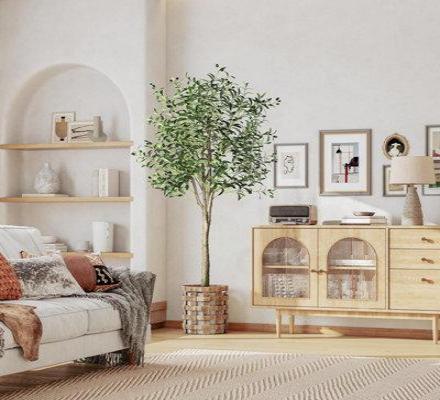
Woven baskets: suitable for natural or boho styles
Ceramic pots: ideal for modern or minimalist spaces
Concrete planters: fit industrial-style interiors
An artificial olive tree with pot looks significantly more natural when the container matches the surrounding decor.
Placement Strategies for Better Visual Impact
Placement strongly influences how the tree interacts with the space.
Effective locations include:
Room corners to add vertical height
Near windows to enhance natural lighting effects
Beside seating areas for balance and softness
Dining areas to introduce vertical greenery without blocking sightlines
These positions allow the tree to enhance depth and structure without occupying functional space.
Light Conditions and UV Resistance
In bright environments, UV resistance becomes an important feature.
UV-resistant artificial olive trees help:
Reduce leaf fading over time
Maintain consistent color in sunlit rooms
Improve durability in bright or semi-outdoor areas
This is especially important for placements near large windows or glass walls.
Applications in Commercial Spaces
Beyond home interiors, artificial olive trees are widely used in commercial environments:
Hotel lobbies
Corporate offices and meeting rooms
Restaurants and cafés
Wedding and event decorations
Retail and branded environments
They are particularly effective in creating a calm, upscale, and welcoming atmosphere.
Key Selection Principles
The best choice is usually the one that balances multiple factors rather than focusing on a single feature.
When selecting an artificial olive tree, consider:
Realism of foliage and trunk
Proper scale for the space
Compatibility with interior style
Stability and structural strength
Low maintenance requirements
A well-balanced tree enhances the environment without overwhelming it visually.
Artificial olive trees combine aesthetic value with practical functionality, making them a versatile solution for modern interior design.
From compact indoor accents to large focal installations, a well-selected faux olive tree can elevate both residential and commercial spaces by introducing natural texture, Mediterranean warmth, and consistent greenery throughout the year.